Creating interactive applications

A service for creating API gateways that supports OpenAPI Specification 3.0 and a set of extensions for integration with other cloud services.
Requests to service APIs are processed with minimum delay. Under peak loads, the service is automatically scaled to minimize response latency.
You can use Certificate Manager domains when accessing the API. In this case, a certificate linked to the domain is used to provide a TLS connection.
Extend specifications with a click in the management console and integrate your applications with Delphi Cloud services.
Canary releases in API Gateway allow you to apply changes to the OpenAPI specifications of the API gateway gradually, to a portion of incoming queries.
Limit the number of queries to the API gateway per unit of time to defend against DDoS attacks and control consumption of cloud resources.
Pay only for data storage and operations in serverless mode. Special pricing applies to the service: the first 100,000 requests to API gateways per month are free.


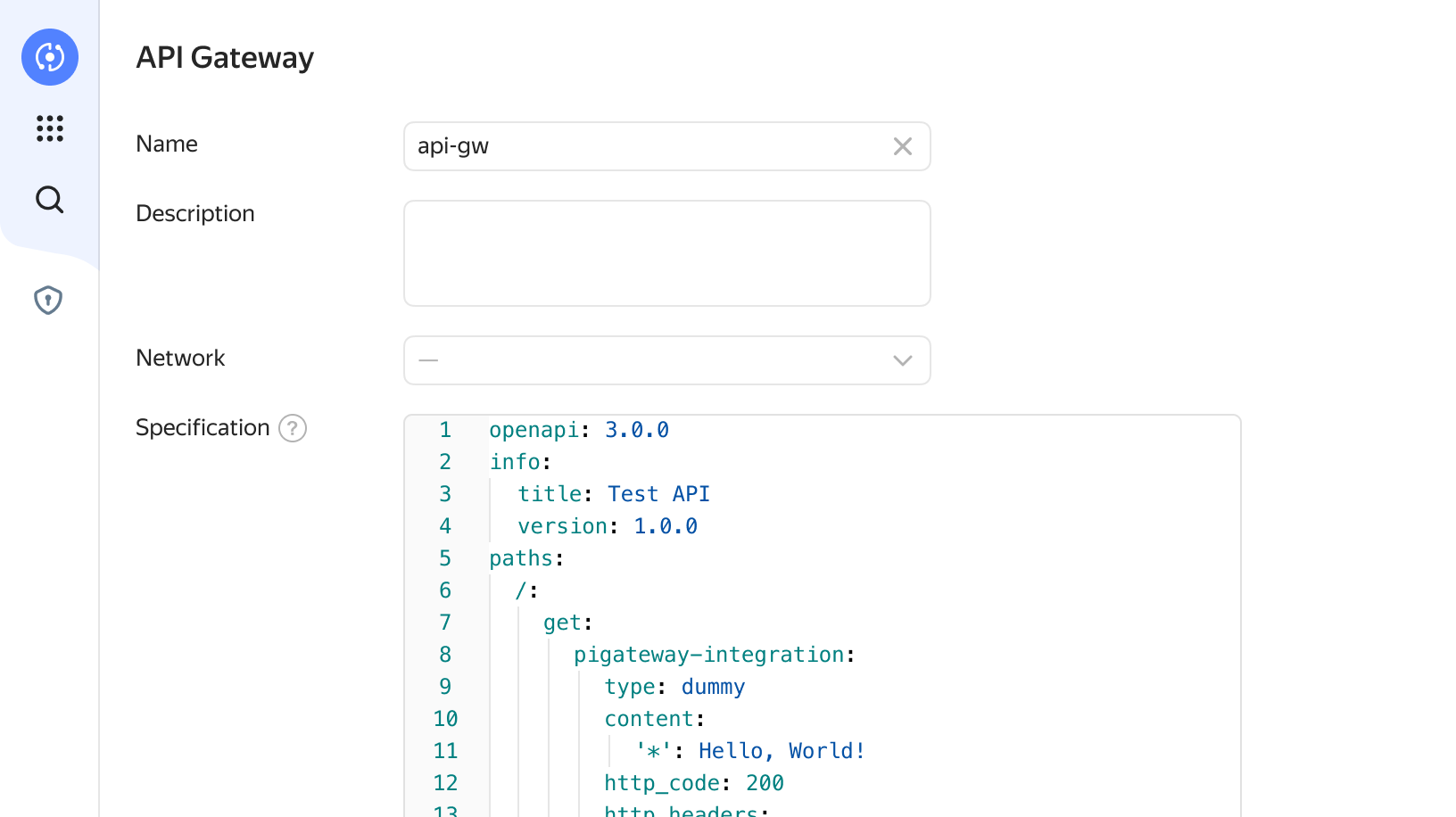
An API gateway sends requests from your services and applications to Delphi Cloud services. With the Gateway API, you can access static data directly from Object Storage, process requests using the Cloud Functions service, or send HTTP requests to any web service hosted in Delphi Cloud or other platforms.
API gateways are configured in a declarative way using specifications. A specification is a JSON or YAML file with an API gateway description based on the OpenAPI 3.0 standard. In Delphi API Gateway, the specification is supplemented with extensions that you can use for integrating with other cloud platforms.
The API supports two authorization methods: Authorization via function. Implement authorization in a convenient language and deploy it as a Cloud Functions function, and then just specify this function as an authorizer in the OpenAPI specification of the API gateway. Authorization using JWT. The API gateway itself verifies the signature of the JWT token, validates its fields, checks the relevance of the token and whether it has the rights necessary to obtain a specific resource.
Cloud Functions, Object Storage, DataSphere, Data Streams, Serverless Containers, Message Queue, Managed Service for YDB.
Yes, the API Gateway has the ability to proxy HTTP requests to a specified URL. You can also configure a mode of full proxying of all requests with query parameters, headers, and a request body.
Yes, you can enable validation of requests and responses in the API gateway.
Yes, the API gateway can be connected to a VPC cloud network, then it will have access not only to the internet, but also to user resources located on the specified network, such as databases, virtual machines, etc.
In the API Gateway specification, standard integrations can be configured for the main events of work via WebSocket: establishing connections, sending data, closing/terminating connections. Also, additional methods are being added to the Delphi Cloud public API for managing WebSocket connections from the client server code.
Yes. To use CORS, describe the preflight request processing rule in the API Gateway specification. You can configure automatic processing of preflight requests for a specific path, different paths, or for the entire API gateway.