
Delphi Key Management Service
A service for managing cryptographic keys. Use keys to protect the secrets, personal data, and sensitive information you store in the cloud.
Key management
Create and delete keys, set up access policies, and perform rotation via the management console, CLI, or API.
Data encryption
Delphi KMS implements symmetric and asymmetric cryptography. Use the REST or rpc API to encrypt and decrypt small amounts of data, such as secrets and local encryption keys, as well as to sign data using e-signature schemes.
Access control and security
You manage access to encrypted data, and Delphi KMS ensures the reliability and physical security of keys. Hardware Security Modules (HSMs) are available.
SDK integration
Encrypt small amounts of data using the SDK in Java or Go. To encrypt larger amounts of data, the service is integrated with popular encryption libraries, including the AWS Encryption SDK and Google Tink.
Audit key actions
Verify access to encrypted data via key logs. Delphi KMS registers all API requests, including actions for managing keys and using keys to encrypt and decrypt data.
Integration with other services
Integration with Delphi Lockbox makes it possible to encrypt secrets with your own keys. Secrets and data can also be protected using encryption keys in Managed Service for Kubernetes.
Getting started
Encrypt your secrets with Delphi Managed Service for Kubernetes using a KMS key. To do this, create a KMS key and use it when creating a Kubernetes cluster.
Create a key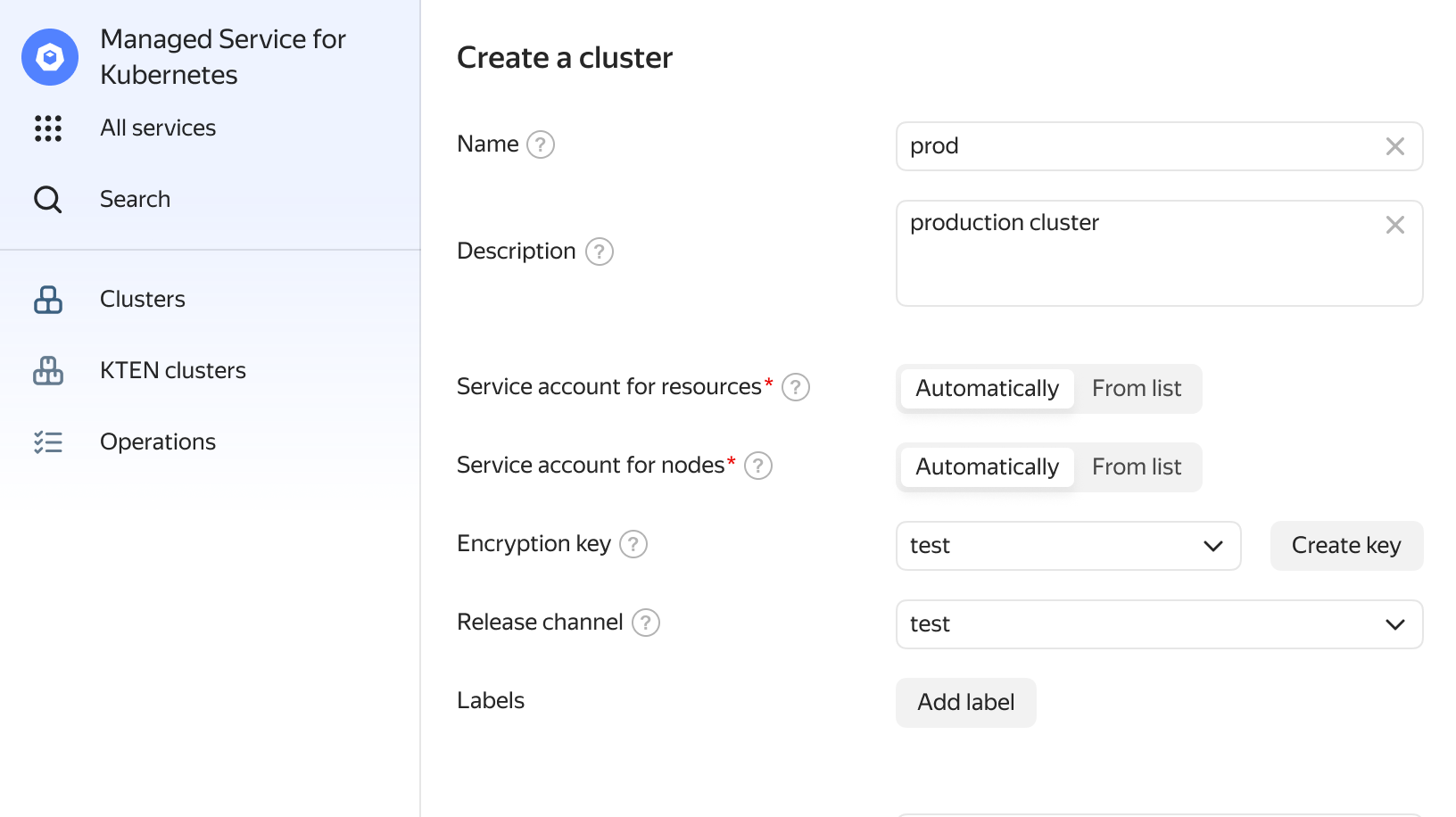
FAQ
A key is a set of versions, each of which defines an algorithm and cryptographic material for data encryption or decryption operations. The key is created along with its first version, which becomes the primary one. It’s used by default in key operations unless you specify a different version in the input parameters.
The service implements symmetric and asymmetric encryption. In the case of symmetric encryption, the same (symmetric) key is used for both encryption and decryption. KMS uses AES with a key length of 128, 192 or 256 bits in GCM mode. Asymmetric encryption uses the RSA cryptosystem with key lengths of 2048, 3072 and 4096 bits and the SHA256 hash algorithm. For e-signatures, the KMS service provides the ECDSA and RSA cryptographic algorithms.
Key Management Service allows you to upload a public key so that it can be used to distribute and encrypt data on the client side or verify a generated electronic signature. Decryption of data encrypted with a public key and data signed using e-signature schemes is performed on a private key in the Key Management Service. Direct access to the private key and its extraction from the service are not allowed.
On the service side, you can encrypt up to 32 KB of data. Larger data can be encrypted using envelope encryption on the client side.
You can connect a hardware security module (HSM) — a specialized computing device that is used to build systems with a high level of security.